It’s hard to do an FAQ post about your novel, when no one’s really asked any questions yet. Specifically because I haven’t really done any marketing yet, and everyone who’s bought a copy is someone I have met in person. Still, my first novel exists as a physical product, so this seems as good a time as any to put together a few thoughts, in the format of an FAQ. Also, I’m keeping these ones fairly general in scope, and I’ll do a more spoilery one about specific events later, if it comes up.

The Cover
I spent an embarrassingly long time on Fiverr trying to pick out a cover artist. It wasn’t helped by my really not knowing what I wanted. I’m not a design guy, after all. I mean you’re reading this on an orange and mustard yellow WordPress blog for fuck’s sake.
Then after over a month of back and forth, a closed account, and a Fiverr refund process, I started again. And the second time I chose better. Much better.
Consider this a full-blown endorsement for the artist who did the cover, Lena Semenkova. If you find yourself in the market for some art with a big bold colourful style, then I heartily recommend her services. Absolute professional.
Future Plans
It is no secret that this is not the end of the story. It even says so in the introduction. Specifically, while I have no intention to stop writing things in this setting any time soon, this story in particular is the first part of a trilogy. I know the tentative titles of books two and three, but I’ve yet to name the trilogy. I’ll have to figure that out when book two is releasing. Not least so I can turn on the hidden subtitle layer in book one’s cover, with the nice place to put the “Book 1 of the ?????? trilogy”.
I allude to this in the introduction to the book, but I started writing purely for fun, with no overarching plan. I wrote away until I had what felt like a story with an ending, in two rough acts with a one chapter epilogue as a finale.
Then I asked the question “wait how long IS a book?”. Shorter than what I’d written, I’ll tell you that much. As it turned out, act 1 had a very natural end point, so I split the file and that first act, after COUNTLESS rewrites, proofing, and editing passes, became Empty Shells.
For some time, during rewrites my plans fluctuated between a single sequel and a trilogy. In one version there was a single sequel with an overgrown epilogue chapter as a payoff element to the events of the story.
However, as I wrote and rewrote it, I found this unsatisfying. It limited the scope for fun asides, fluff, and world building in “act 2”, and left very little scope to explore what was happening in the epilogue, which increasingly felt to me like I was just showing a slice of the end of “act 3” without showing how this came about.
So, once again, the file was split, with me finally settling on a definite three act story, each part having a start and an end, a clear thread running through them, and plenty of space for me to explore.
Where do we stand now? Book 2 is undergoing a last few rewrites. I’ve recently reread it, and having been away from it for a while reviewing Empty Shells, and coming back with a fresh set of eyes, I’ve seen a fair few areas that need revising. Structurally, though, it’s all there. Over the next few months I’ll plug on until it feels right, but it’s smallish changes for the most part. And the ever present proofing and editing of course.
Book 3 needs a lot more work. The shape of the “A story” is in place, but I’ve got some additions and improvements in mind. The “B story” is in a much earlier state, but reading and rereading it made me feel that it was sorely needed.
As for the titles? They’re a little spoilery, so I’ll hold those for now.
Why this story?
Empty Shells is kind of the third thing I’ve started writing. The first was a sci-fi story, which I do intend to come back to and finish, at some point. The second was “The Monsters Among Us”, which I do a little bit on from time to time, but is mostly sitting in my head (and which started in concept as RPG source materials).
I talk about this in the introduction to Empty Shells, but when I was thinking about some of the chapters I wanted to do in MAU I put in one with Bariel and Sully, a married angel and demon couple. Then I started wondering how this fit into the wider setting I was building in my head, how religion, the afterlife, and angels and demons “worked”.
Then I kind of slipped sideways into wanting to do something with the Heaven and Hell side of the setting, and ended up sitting down one day and saying to myself “just start writing and see what happens”. And this time, I didn’t stop. And in the process I ended up getting attached to both the setting and the characters.
Oh, and for the record, that sci-fi story, MAU and Empty Shells are all in the same setting.
Why these characters?
Other than Bariel and Sully (who will be appearing in both one of the sequels to Empty Shells, and MAU in an upcoming chapter) I started with two distinct concepts, and as is so frequently the case with me, I decided to take both and roll with them.
The first, which I think arose while brainstorming some of the mechanical aspects of Hell in the setting, was Fin and Ash, having their chat in Ash’s room in the labyrinth. Barring some additions, that scene has actually stayed remarkably similar to my original thoughts on the topic. The concept of curses, and of the labyrinth as a cruel pseudo-purgatory came about here. I toyed with various possible relationships for Fin and Ash, whether they would be blood relatives or a romantic couple, but I found myself quickly preferring the “devoted best friends” path. Not least because it said something immediate about both the setting (this wasn’t a fire and brimstone Hell for bad people) and about the characters themselves (Fin’s decades long refusal to abandon his friend).
Ash has barely changed since that first planning session. Somehow in my head they always seem to be “just Ash” and changing them is unthinkable for some reason. Fin, however, did change somewhat. In that original concept his physical changes in the afterlife were far more pronounced. His original design concept was more reptilian, with him intended to be scaly, and to possess a tail and a more reptilian facial structure. Part of the thought at this point was that curses led to more pronounced physical and psychological changes, which I ditched fairly early on, with curses becoming more “something that happens to you, separate to the physical changes”. I think in part because I wanted it to not be immediately obvious who had one.
A key part of Fin’s place in the stories I was thinking up was that he had an established place in Hell. I also, once the concept of the labyrinth was in my mind, wanted someone who had no idea what the hell was going on. And that’s where Mikey came in. Firstly, I will admit here that I was embarrassingly far into writing the story when I realised that his original name was a truly terrible pun and ctrl-h’d it out of existence.
Mikey, too, had a much more monstrous nature in the first concept, while his physical design was similar to how it’s described in Empty Shells. That early version of him had a combination of his curse induced hunger, and a biological inability to eat anything but rotten carrion due to his fly biology. I dialled this back in very short order because frankly he’d have just had far too miserable a time for me to enjoy writing him.
For some reason I don’t fully comprehend, Reggie and Scamp kind of came into existence beside him. I think in that earliest hazy concept he met the imps while raiding bins for rotting meat, before encountering Fin for the first time. Scamp pretty much ended up riding around on his shoulder from that point on, and there wasn’t much I could do about it.
Then there’s Nox. I wasn’t joking in the introduction when I said he just turned up and refused to leave. I was writing the chapters with Mikey in the Waystation, and he just sort of appeared when I was writing it. His appearance stayed more or less unchanged from the moment I wrote his debut. His backstory was pretty much done that night, too. It was only a few details like his job and the bike that came a little later in the process.
Why so violent/horny/gay?
Okay, so roll with me on this one. It was an early decision that permanent death, for angels and demons of all kinds, would be an outstandingly rare thing, which pretty quickly became an integral part of the plot of the trilogy.
Now, when you think of a setting where people for the most part can’t die, and injuries are temporary, then that is naturally going to be reflected in the society that creates. People would be much more cavalier about personal safety, much more willing to take risks, and equivalently less concerned about violence and injury. This is reflected in the story.
As are some of the concerns that would be introduced by this. The fear of captivity, and by extension “the rule”, etc.
Now, this, in a way, flows to the second part of our question. If I’ve settled on a setting where violence is commonplace, and in fact an essential part of the story, which it doesn’t shy away from portraying… It feels prudish to then self-censor crude and sexual humour, and implied and actual sex. Especially when the sex in question is between consenting adults.
As to the general horniness, and directness of the characters, this comes from another societal consideration of the setting. In Hell, as it’s presented, it’s the case that the characters are acting in an environment where taboos and societal expectations of a certain type of behaviour are simply not present. Pregnancy is not a thing for the formal mortals, nor are STDs for the most part, so they mostly do what they like with who they like.
In my mind, when some newly dead person makes it out of the labyrinth and into the border cities, and deals with the immediate “oh fuck I really am dead” issue, there’s a kind of culture shock effect. Most people, especially people who were, for whatever reason, to some degree repressed in life start out trying to keep their head down a bit, realise quickly enough that no one gives a shit, and then kind of throw themselves into a bit of debauchery until they’ve worked it out of their system (and in most cases find themselves a new baseline which is a tad higher on the casual debauchery scale than when they were alive).
It’s also the case that in the setting “unconventional relationship dynamics” are much more common and accepted. Mostly coming, again, from that absence of an expectation that “two person heterosexual relationship” is the default. Now there’s still a lot of that, because statistically most people are straight, but there are more casual relationships, poly relationships, and other dynamics than in the real world.
An element of that being that people here are effectively immortal. There are people who have been in dedicated relationships for millennia, and others who have ended relationships after years or decades because they as people have changed, or the relationship has run its natural course (remaining in an unhappy marriage is vanishingly rare in Hell for a variety of reasons, not least of which is the stipend). And the same applies to poly relationships, with immortality granting people all the time to live in different ways and find out what makes them happiest.
A point to bear in mind, too, which isn’t really raised in the book itself (because it just doesn’t naturally come up) is that we only really see locations in the border cities and close to them. Places like Indigence and Diligence which are still the most “modern day Earth-Like”, and where age 300 is considered old. Things can get weird, the deeper you go into Hell.
And that brings me to the last part of the question. It’s been noted to me that, among the primary cast at least, the demographics lean very LGBTQ+, and that this could, hypothetically, be misinterpreted. So, to answer this in two parts:
1: My protagonists, in this story at least, are queer because I’m bisexual and just decided to write them that way because when I was planning them out I’d made my characters and decided I wanted my OCs to kiss, and they were already both boys (and then Nox turned up, and I just shrugged and let him stay). So there. And that, naturally, leads narratively to some of the people around them also being that way inclined, or of the more accepting mindset.
2: The fact they, or anyone else for that matter, is in Hell has absolutely nothing whatsoever to do with their race, sex, gender presentation or sexual preferences. It’s implied at various points in the story that humanity has historically misunderstood how the afterlife, demons, and angels, work. This inludes the selection process for the afterlives. To be explicit: within the setting of these stories, Hell is not a punishment, it’s the default. Everyone goes to Hell, unless they meet Heaven’s mysterious selection criteria (which I will go so far as to say at this point, without making excessive spoilers, is primarily based around a person’s proportional contribution to the good of the world and the people around them).
Why the chapter structure?
The chapter intros came about for two reasons. The first is that one of the major things I struggled with in the past was working out how the hell to start a story. Add to that that a lot of my writing experience comes from D&D games, which involves a lot of environmental description and lore construction (often on the fly because your players have DONE IT AGAIN). So when I started writing, having roughly that first chapter in mind, I started, instead of going straight to business, with describing the labyrinth as if I was narrating the opening to a campaign.
I stuck with them because they gave me a fun way to give out related (or at least tangentially related) pieces of lore in each chapter without the need to have characters stop what they’re doing and explain them. Especially if they themselves aren’t fully informed. It means I can do things like introduce curses in a way that characters never would in dialog, and limit how much of that conversation they have to have “on screen” to the parts that are relevant to character and events. I try, for the most part, to tie each one in part to the events of the chapter, but it varies how much I stick to this.
In my head if I ever do an audiobook the chapter intros and the chapters themselves would have seperate narrators.
What’s with the footnotes?
I always loved Pratchett’s use of footnotes for little asides, and there’s an element of “shameless tribute” in my use of them. Also, though, when I’m writing I think of some joke or aside or anecdote and think “what the hell” and throw them in. I’ve been told that if you know me, they practically sound like me, which amuses me no end.
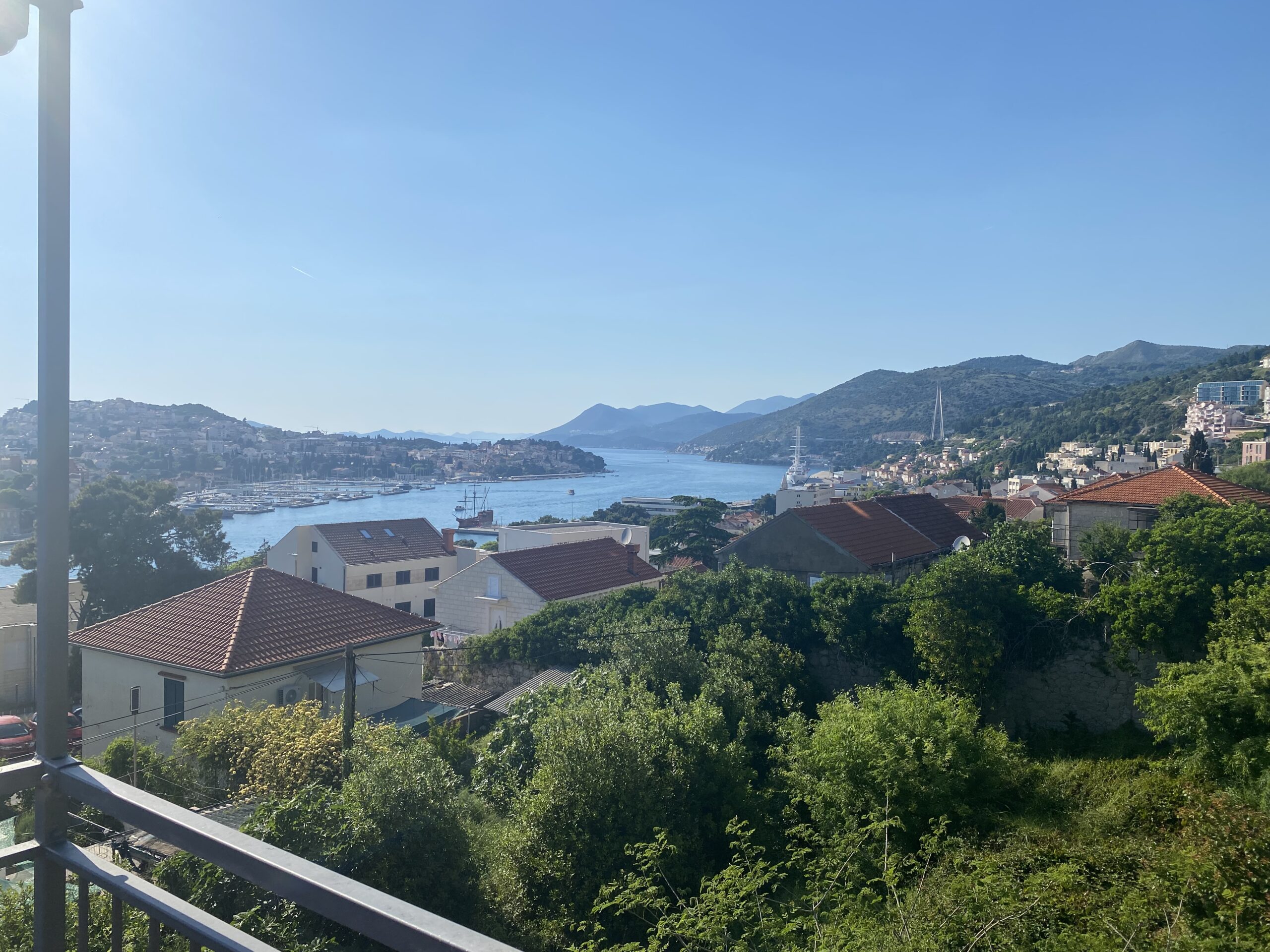
For no real reason, I’m going to end this with a photograph I took from the roof terrace in Dubrovnik where I wrote a small part of book 3. Mostly because the world needs to see this view.




You must be logged in to post a comment.